
Can Chiropractic Care Improve Kids’ Athletic Performance? A Young Swimmer’s Story
- Categories:
- Blog
- Why We’re in the Media
Evidence-based and results-driven chiropractic care can help athletes improve strength, mobility, and recovery by optimising spinal and nervous system function. When most people think of chiropractic care, they think of back pain, posture, or injury recovery. But emerging research is beginning to explore something far more interesting: the impact of chiropractic adjustments on the brain, nervous system, and overall human performance.
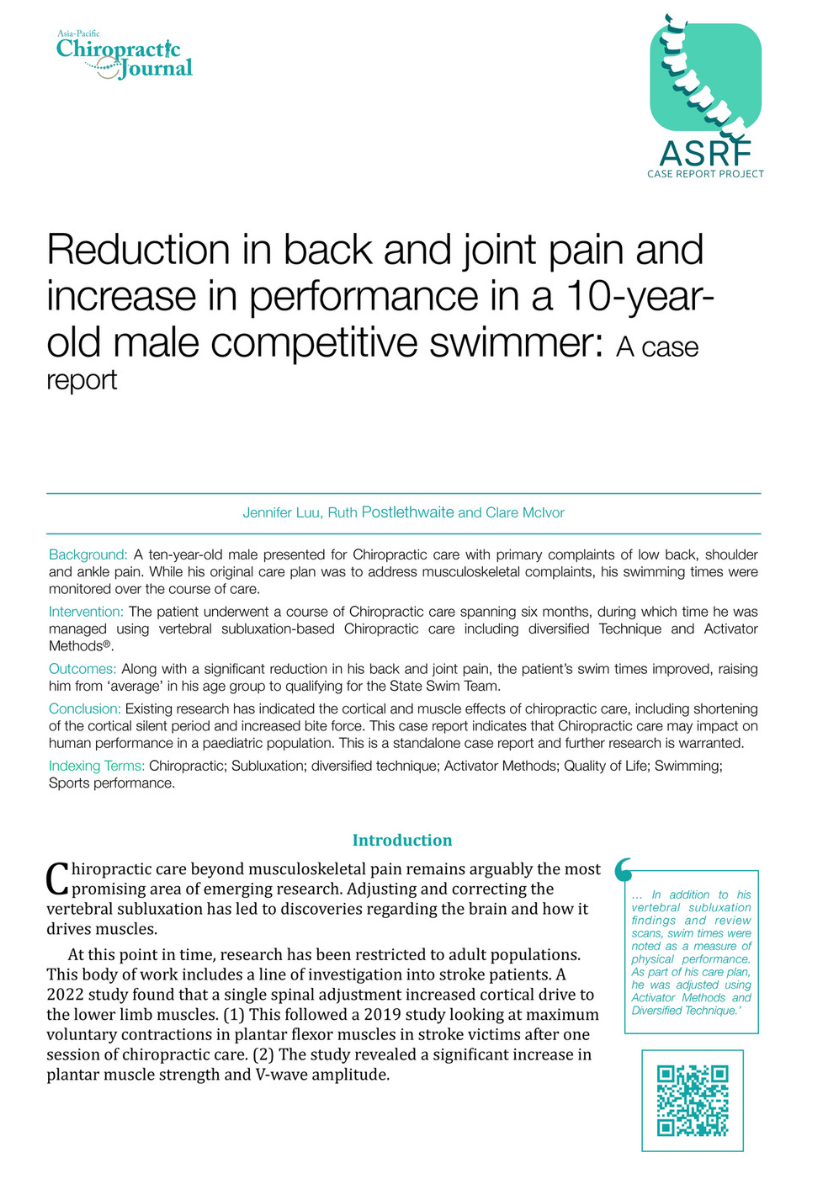
Our recent published case report highlights this potential through the story of a 10-year-old competitive swimmer—and the results are hard to ignore.
From Pain to Performance
The young athlete initially sought chiropractic care for fairly common complaints: lower back pain, shoulder discomfort, and ankle pain. As a dedicated swimmer training five days a week, these issues were beginning to affect both his comfort and performance in the pool.
While the primary goal was to reduce pain, something else was tracked along the way—his swim times.
What Changed?
Over a six-month period, the swimmer received regular chiropractic care using Diversified Technique and Activator Methods®. His care plan focused on identifying and correcting vertebral subluxations—areas of spinal dysfunction that may interfere with nervous system function.
During this time:
- His back, shoulder, and ankle pain significantly decreased
- His posture and spinal movement improved
- And most notably—his swimming performance improved dramatically
He went from being “average” in his age group to qualifying for his State Swim Team.
The Numbers Tell the Story
The improvements weren’t small. His times dropped significantly across multiple events:
- 200m Freestyle: Improved by 29.2 seconds (nearly 10%)
- 200m Breaststroke: Improved by 12.7 seconds
- Consistent improvements across 50m and 100m events
These gains happened without any major changes to his training routine—chiropractic care was the only new variable.
What Does the Science Say?
This case doesn’t stand alone. Previous research has shown that spinal adjustments can influence how the brain communicates with muscles.
Studies have demonstrated:
- Increased muscle strength after a single adjustment
- Improved “cortical drive” (the brain’s ability to activate muscles)
- Enhanced sensorimotor integration (how the body processes movement and position)
- Shortened cortical silent periods, meaning faster and more efficient muscle activation
In simple terms, chiropractic care may help the brain and body communicate more effectively—something that’s critical for athletic performance.
Why This Matters for Kids
Most of the existing research has been conducted on adults, including stroke patients and elite athletes. This case is unique because it explores these effects in a child.
It raises an important question:
If chiropractic care can enhance nervous system function in adults, could it also unlock performance potential in younger athletes?
While this is just a single case report—and more research is needed—it opens the door to exciting possibilities.
A Broader Perspective
It’s important to stay grounded: this is not definitive proof, and improvements in young athletes can come from many factors, including growth, training, and motivation.
However, the timing and magnitude of the swimmer’s improvements—particularly early in care—suggest that something meaningful may have been happening beyond natural progression alone.
The Takeaway
This case highlights a growing area of interest in chiropractic care: its potential role not just in reducing pain, but in enhancing human performance.
For this young swimmer, chiropractic care didn’t just help him feel better—it may have helped him perform better, too.
As research continues to evolve, we may begin to better understand how optimsing the nervous system could play a role in helping people of all ages reach their full potential.
Reference: Luu J, Postlethwaite R, McIvor C. (2025). Reduction in back and joint pain and increase in performance in a 10-year-old male competitive swimmer: A case report. Asia-Pacific Chiropractic Journal.
Asia-Pacific Chiropractic Journal | Papers Issue 6-1
Dr. Jen is the Vice President of the Australian Spinal Research Foundation, where you will find many of our current clients partaking in our Case Studies project to showcase our contribution to chiropractic research.